
Source: UiB.no
Researchers at the Department of Earth Sciences at the University of Bergen have discovered Norway’s first known oil volcano on the seafloor of the North Sea. The discovery shows that crude oil can seep out from underground in far greater quantities than previously thought, and may provide new insights into both geological processes and future CO₂ storage.
WATCH THE VIDEO:
A sensational discovery by researchers at the University of Bergen could provide new insights into both oil spills and future CO₂ storage
At a depth of 70 meters in the North Sea, researchers from the Department of Earth Sciences at the University of Bergen have made a discovery that no one has previously documented in Norway: an active oil volcano on the seafloor.
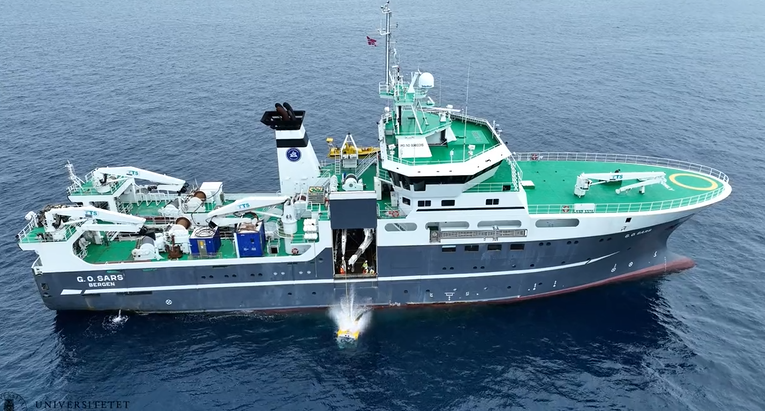
Using the remotely operated underwater vehicle Ægir6000, the researchers identified a small volcano-like structure that continuously releases a mixture of water, sludge, gas, and crude oil directly onto the seafloor.
“It was previously believed that the oil in the North Sea had remained securely trapped beneath the seafloor, but we have now found evidence that in some places it is seeping out in fairly large quantities,” says Professor Christian Haug Eide of the Department of Geosciences.
Oil has been leaking for thousands of years
The newly discovered oil volcano is about two meters high and around 30 centimeters wide. Researchers estimate that it may be releasing several hundred liters of crude oil every day. Preliminary analyses suggest that such releases may have been occurring continuously for several thousand years.
The finding challenges established notions about how effectively oil and gas have been trapped underground since the formation of the North Sea's petroleum reservoirs.
“This shows that geological systems are more dynamic than we previously thought. Natural leaks from underground can occur over very long periods of time,” says Haug Eide.
May provide answers about future CO₂ storage
The discovery is not only of interest to petroleum geology. Researchers believe the finding could be significant for our understanding of underground fluid flows in general, including how CO₂ behaves when stored in geological formations.
When large amounts of CO₂ are to be stored deep underground and on the seafloor in the future, knowledge of natural leakage pathways will be important to ensure that the storage remains safe over long periods of time.
“If we are to store CO₂ in geological reservoirs for hundreds or thousands of years, we need to understand how liquids and gases can migrate through the subsurface. Discoveries like these provide us with valuable insights into precisely this,” the researchers explain.
Life Around the Oil Volcano
The researchers are also investigating whether the leaks have created a distinct ecosystem on the seafloor. It is well known internationally that natural oil and gas leaks can provide a habitat for specialized microorganisms and animal communities that feed on the chemical compounds seeping out.
Samples from the area are now being analyzed to map both the geology and the biology surrounding the newly discovered structure.
See the discovery with your own eyes
The discovery was featured on "Dagsrevyen" and has received widespread national attention.
Watch the Dagsrevyen segment on the discovery. (external link)