
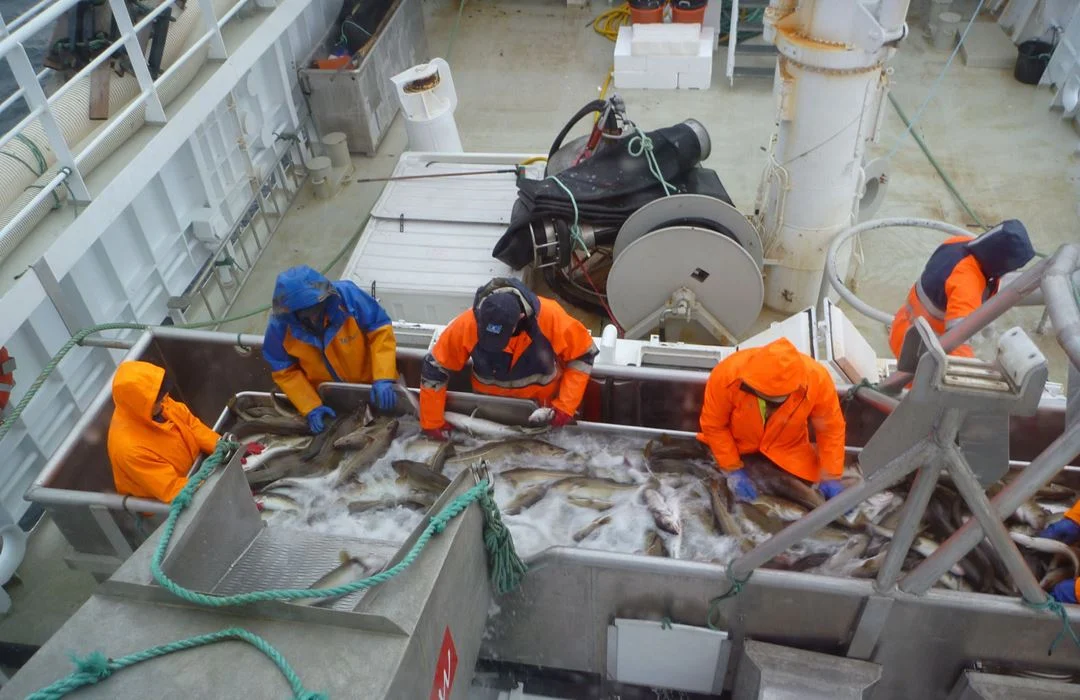
Source: SINTEF and Fiskeribladet. This op-ed has been republished with permission from SINTEF.
Norway's most important emergency stockpile cannot be replenished when a crisis strikes. It must be managed while we still have it.
We’re talking about food more and more often in the same breath as emergency preparedness. In those cases, the focus is usually on grain reserves, supply lines, electricity, and fuel. That’s necessary.
Annette Brede and Arnt Ove Løvås are absolutely right when they write in an op-ed in *Adresseavisen* that “Norwegian food is not just food. It is preparedness. It is security. And it is our first line of defense.” I completely agree. But Norwegian food doesn’t come only from the land. It also comes from the sea.
Fish from the sea can—and should—be a key emergency resource. Of course. Minister of Fisheries and Marine Affairs Marianne Sivertsen Næss also emphasizes this point in *Fiskeribladet*. But the discussion cannot focus solely on the role the seafood industry should play when a crisis strikes.
It must also highlight what needs to be in place to ensure that resources from the ocean can continue to provide food for our tables when society is under pressure. This requires that fish stocks and ecosystems remain available for sustainable harvesting—because the ocean is not a stable food store that is ready to be tapped whenever needed.
It needs to have a clearly defined place
The industry is right that seafood must be given a more prominent role in the debate on emergency preparedness. But that role depends on the ocean continuing to deliver when it matters most. Because the ocean is changing. All the time. Species are migrating.
Some are leaving Norwegian waters—others are entering. Recruitment has been sluggish at times.
Climate change affects both fish and the food sources on which they depend. If seafood is to be a genuine emergency resource—and not just a claim made in the emergency preparedness debate—we must ensure that our industry can help mitigate the effects of these challenges before a crisis strikes and emergency preparedness becomes more than just a word.
This is not an argument for downplaying the importance of fisheries when it comes to food security. On the contrary.
The fishing industry is an important part of the solution to the emergency preparedness challenges Norway faces. The industry deserves to be recognized for this as well, on an equal footing with food produced on land.
But seafood preparedness that is meant to last over time cannot be limited to how we mobilize resources when a crisis strikes. It must also address how we preserve the very foundation of production before a crisis occurs.
And here, the contribution from the fishing industry itself will become increasingly important—especially when it comes to adapting to all the changes taking place in the ocean while also ensuring a good livelihood.
Technology is management
However, in order to contribute in the best possible way, they must have access to solutions that work on board and are feasible to implement—solutions for sorting and better managing bycatch to reduce the impact on vulnerable species.
Equipment with minimal impact on the seabed to protect vulnerable areas.
Automatic catch recording that can provide more information about what is caught, where, and when. Decision-support tools that can optimize operations and reduce fuel consumption.
These are not technologies for technology’s sake. They are practical tools that must be (further) developed so that the fishing industry can continue to harvest from the ocean even as the ocean changes. Solutions that can be used in the industry—solutions that the industry itself has helped to develop.
But technology does not automatically constitute good management simply because it is new—not even if it has been developed in collaboration with the industry. In a workshop with fishermen, managers, and researchers for the EU project MarineGuardian earlier this summer, this was precisely the point made by the participants.
The decisive factor, they said, was not simply whether a boat had installed a sensor of some kind—whether it was a camera, a laser, or a video system. Nor was it decisive whether this sensor could measure the size, weight, and species of the fish being caught.
What would be crucial was whether the measurements could be relied upon. Whether the technology worked on board. And whether the data captured by the sensor could actually be used in a way that would be valuable to fishermen, management, and research.
More information
Participants in the workshop also pointed out that better and more up-to-date information on volume and species composition from these types of sensors could provide a comprehensive picture of how much is actually absorbed by the ocean.
This, in turn, can make it easier to adjust fishing practices as the composition of the catches changes, and provide management with a better basis for evaluating measures.
But data is not neutral simply because it is digital. It must be reliable, difficult to manipulate, and understandable to those who will have to live with its consequences.
In addition, the participants pointed out that there is no one-size-fits-all solution when it comes to technological innovations for fishing vessels. What is practically feasible on a large vessel is not necessarily feasible to install on a smaller boat with limited space and other operational requirements.
And if the installation of new technological solutions is perceived as yet another requirement imposed from above—without solving a problem for the fisherman or providing a better foundation for both income and increased trust—it quickly becomes a burden.
If, on the other hand, it can reduce uncertainty, simplify reporting, and support more targeted fishing, it could become part of the solution.
During a similar workshop in Canada—which included other fisheries facing different challenges than those represented at the Norwegian workshop—similar challenges were discussed.
The discussion focused mainly on the impact of bottom trawling, bycatch, and whales becoming entangled in the ropes of snow crab pots. The technologies discussed included gear with less impact on the seafloor, acoustic solutions that can reduce the risk of whales becoming entangled in ropes, and more active sorting in the trawl to avoid bycatch before the catch is hauled in.
Are transferable
Most of these challenges are applicable to both Norwegian and other European fisheries. The discussions in both workshops also highlighted an important common feature: namely, that a prototype of a technological solution cannot solve these challenges on its own.
New equipment must be available when needed, be able to withstand the conditions in the field for which it is designed, and be affordable. Fishermen must have the time and expertise to use it. Regulations must be predictable and, ideally, flexible, given that the ocean is constantly changing.
And it must be clear what the data will be used for—and by whom. Such technology—which reduces bycatch, reliably and automatically records catches, and minimizes impact on the seafloor or the risk of conflict with vulnerable species—can all help preserve the foundation for future harvesting and ensure that seafood is viewed as a more reliable emergency food supply.
But, of course, technology cannot generate recruitment when fish stocks are declining. Nor can technology counteract the effects of warmer oceans, altered food chains, or species that are migrating.
However, if it is developed through collaboration between the industry, government, and the research community, it can give the fishing industry a better chance to detect changes earlier, fish more selectively, and reduce unintended impacts before the foundation for future sustainable harvesting is undermined.
When we talk about seafood as part of our emergency preparedness, we must therefore consider more than just how much fish we can harvest from the ocean during a crisis. We must ask whether the decisions we make in peacetime make the ocean better or worse equipped to produce food when we need it most.
Norway's most important emergency stockpile cannot be replenished when a crisis strikes. It must be managed while we still have it.